Šimon Herrmann Dróny 20. 11. 2026 – 6. 12. 2026
Curator: Agáta Young Hošnová
There are sounds that blur the boundary between the external world and the things we carry within ourselves. The audiovisual exhibition Dróny, presenting the artistic research of Šimon Herrmann (PhD candidate at FAMU), dives into the realm of drones, sustained aural tones evocative of primal experience. While drones appear unchanging, minimal harmonic shifts in drone composition occasion a timelessness, eluding the conventions of rhythm or melody.
This rumbling soundscape does more than invade quotidian reality: it constitutes our experience of the world. Through sound, the familiar blends with the intangible into an ambivalent and transcendent force – from terror to ecstasy, from God to the Devil, from peaceful meditation to apocalyptic premonition. The drone vibrating the exhibition space embodies a spectrum of uses and natural occurrences. We hear deep drones in our mother’s womb, safe and soothing for the growing embryo; yet we also perceive drones in conflict, as the signifier of threat and the proximity of military machinery.
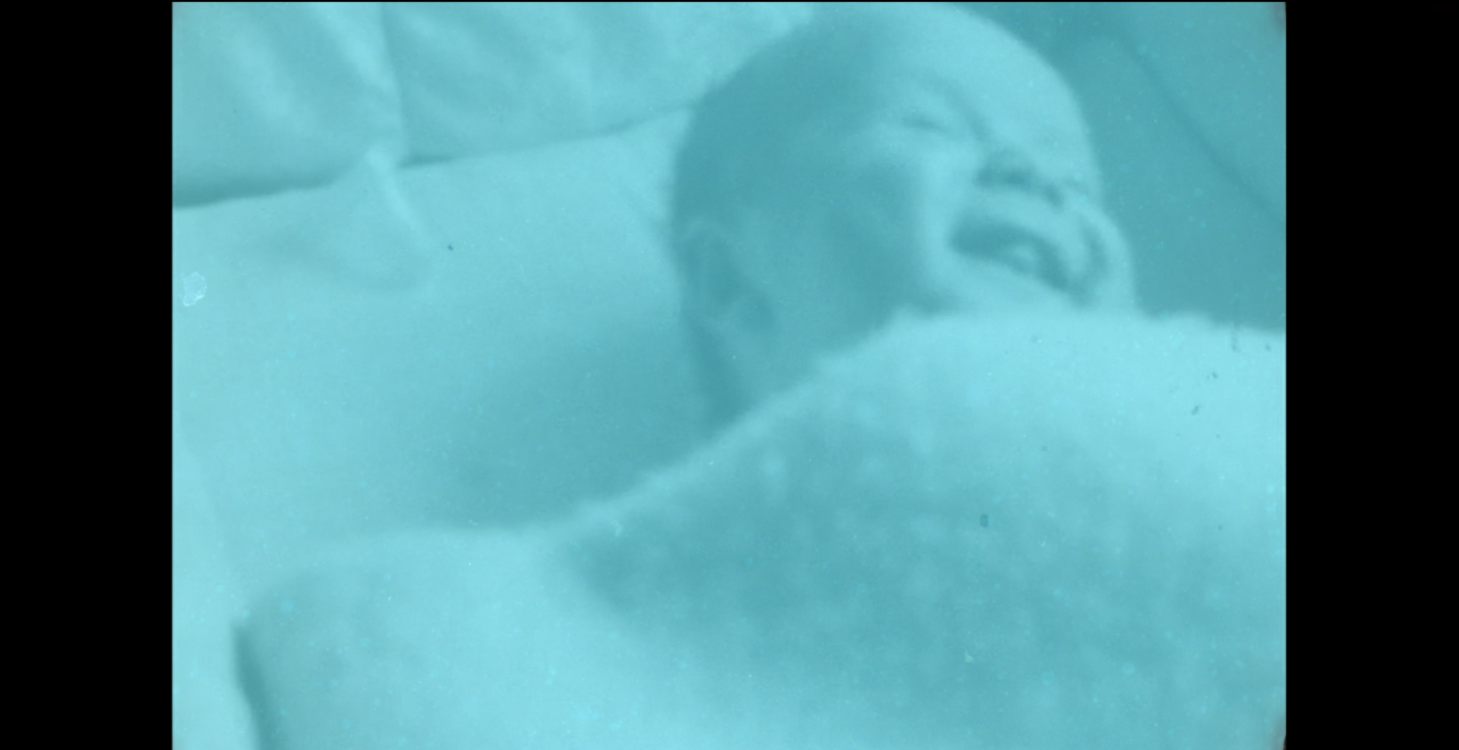
The centrepiece of the exhibition is Herrmann’s film The Liminal Hum, which the artist created using footage from Jan Šikl’s Archive of Private Film History. This audiovisual essay consists primarily of shots of anonymous children and their expressive facial expressions, which, much like drones, do not allow for an unambiguous interpretation. Using Lev Kuleshov’s cognitive theory of editing, Herrmann draws a parallel between auditory and visual material, demonstrating that the subconscious meaning of images is context- and sequence-dependent. The same may be true of drone sound.
In the pivotal moment of the film, a baby is tossed into the air by his father. This fleeting moment of suspension in mid-air, lingering before gravity, is held in place to punctuate the tension within the drone. The drone is at once menacing and soothing, an orgasmic depth vibrating through our bodies, and the fear of our ultimately helpless fragility in freefall.
Auditory memory is often undervalued compared to sight, smell or taste. A conscious memory of our mother’s womb lies beyond our recollective reach. Once-indecipherable auditory meanings begin to assume unsuspected connotations in later life, new sociopolitical meanings, despite the stasis of their physical circumstance. The motion of drone sound is intrinsically physical, ritualistic and difficult to communicate in language, and precisely for this reason the drone has such a profound emotional effect. The expressions of babies demonstrate as much.
The exhibition’s architecture, designed by Medard J. Zeman, aims to complement this soundscape with materials as dense as the drone itself. Supersized metal objects allude to a transcendent scale of sound, amorphous shapes suggesting an elusive acoustic atmospheres, and a fluid nature of interpretation. The programmed soundscape combined with the reflective properties of these surfaces produces a fluctuating level of noise which naturally transitions into silence depending on visitor movement. Sound is the key ingredient in the audiovisual essay; here, an invitation to movement is made to the audience as they drift through the space, and by the presence of these unspecified acoustic objects – materialised drones.