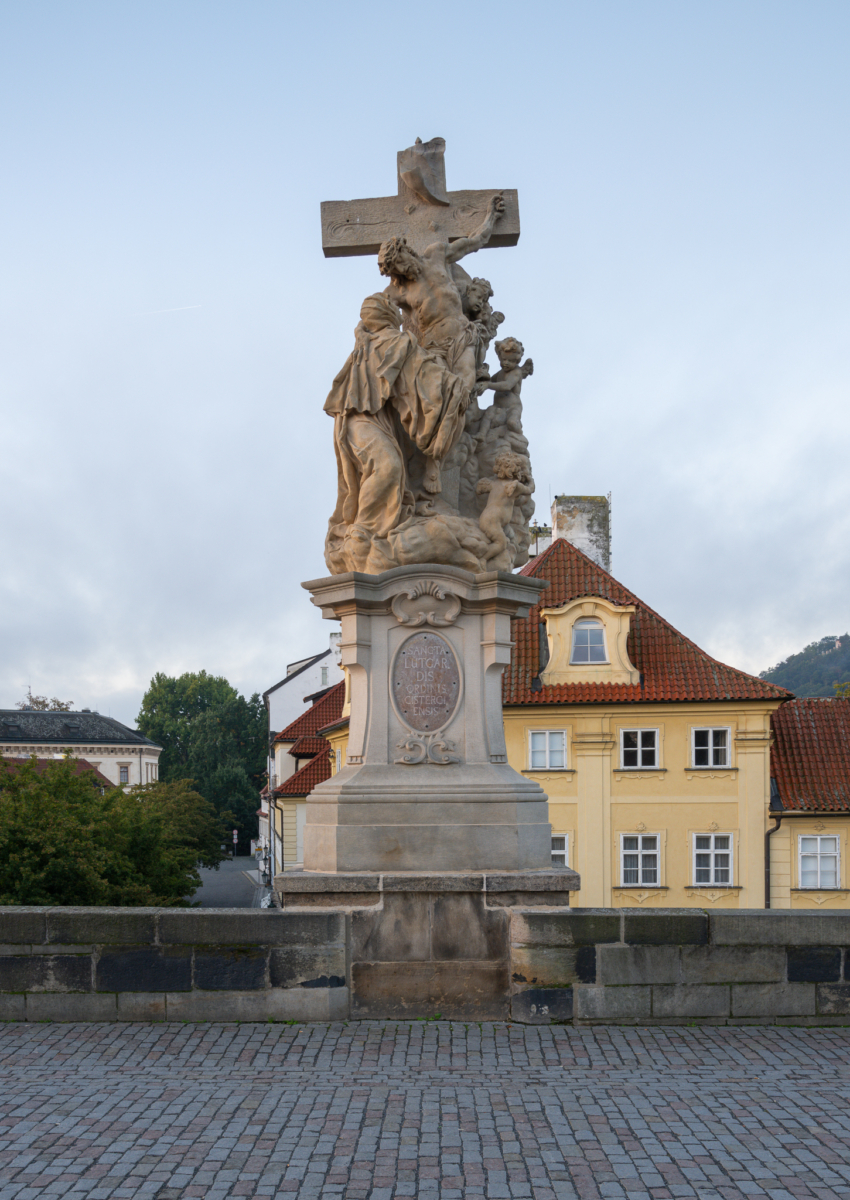
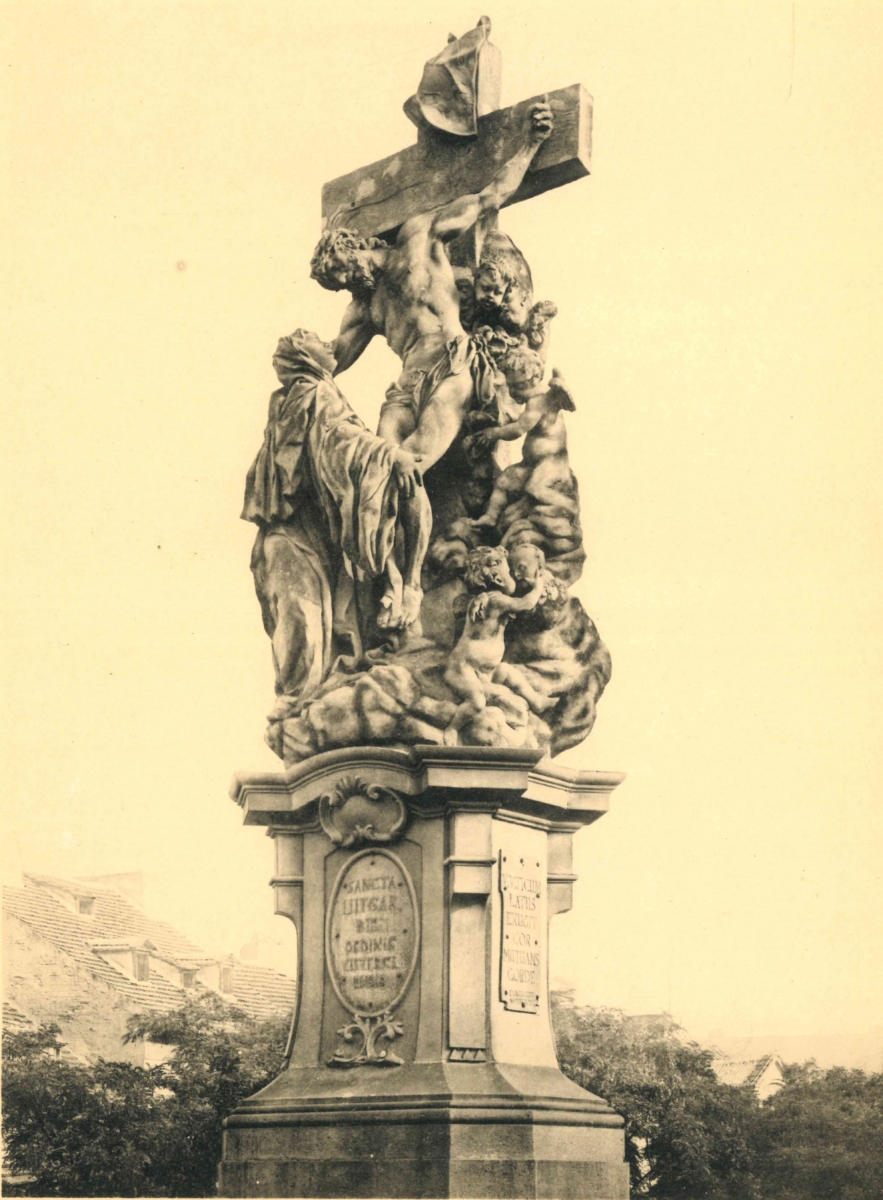
Sculpture of the Vision of St. Luitgarde
The sculpture depicting the Vision of St. Luitgarde is one of the earliest documented works by the prominent High Baroque sculptor Matthias Bernard Braun. The sculptor created it on commission from Eugene Tyttl, abbot of the Cistercian monastery in Plasy, and it was installed on Charles Bridge in 1710. In 1995, the Baroque original was replaced by a copy made of Hořice sandstone, made by sculptors Jiří Novák and Bořivoj Rak. The copy of the pedestal, likely designed by architect Franz Maximilian Kaňka, was made of Božanov sandstone, while the three oval medallions were crafted from light pink Slivenec marble. Some scholars believe that Braun may have based his concept for the sculpture on a drawing by Petr Brandl. The painter himself used the same theme in a 1729 large-scale oil painting for the Cistercians of Sedlec, rendered in a similar iconographic style. The sculpture depicts the mystical experience of the blind Cistercian nun Luitgarde, typical for Cistercian piety. The crucified Christ wraps his relaxed right arm around the neck of the ecstatic saint, who is about to kiss the bleeding wound on his side. The pair is surrounded by a cloud-like mass with a swarm of assisting angels. In terms of both the subject and the quality of execution, the work ranks among the most significant works of contemporary sculpture. In his characteristically expressive manner, Braun rendered the musculature of Christ’s tortured body, brought to life by the shifting play of light and shadow; special attention was also paid to the modeling of the folds of the rich robe in which the saint’s body is completely clothed. St. Luitgarde’s profound inner experience is fully expressed in the moved expression of her devoted face, which, in moments of loving compassion, mirrors the pain-tortured gaze of Christ’s face; this is also suggested by a quotation from the Cistercian breviary in one of the cartouches on the pedestal: “VIVIFICUM LATUS EXUGIT COR MUTUANS CORDE,” meaning: “The living hip gave forth a heart, which it exchanged for a heart.”