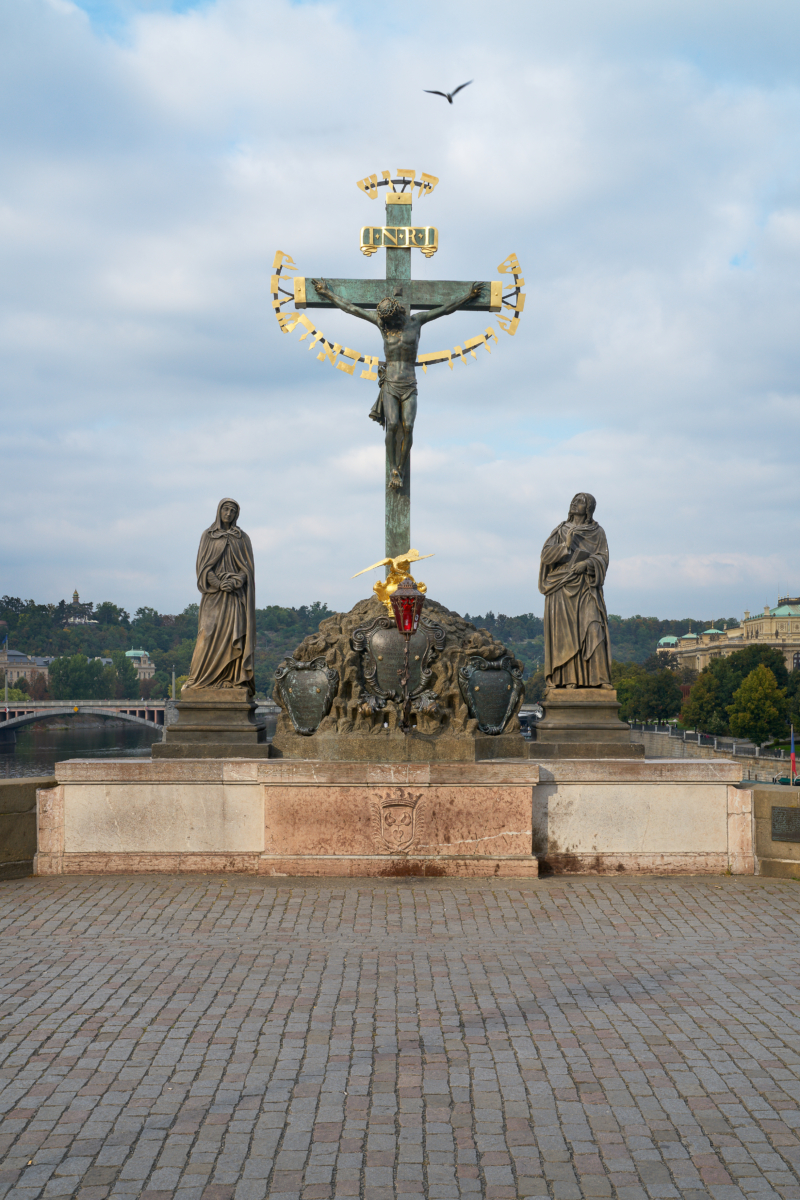
Sculpture of the Holy Cross with Virgin Mary and John the Evangelist
The current appearance of the sculpture of the Holy Cross with Virgin Mary and John the Evangelist is the result of repeated alterations and modifications. The current bronze figure of Christ by Wolf Ernst Brohn was purchased in Dresden in 1657 and mounted on a wooden cross in 1659. After falling into the river in 1707, the wooden cross was replaced with a bronze one. The artificial rock with skulls, frogs, and lizards, in which the bronze cross is set, was created by the Dresden sculptor Johann Georg Heermann, who was working in Prague at the time. It symbolizes Golgotha in Jerusalem, the actual site of the execution of Christ. The gilded Hebrew inscription, which translates to “Holy, Holy, Holy is the Lord of Hosts, Isaiah 6:3,” was made in 1696. Initially, it was meant as a penalty for Eliah Bokckofen, a Jew who was unjustly punished in this manner for alleged blasphemy against the Holy Cross. Even slightly older is the breastplate made of pink Slivenec marble, bearing the coat of arms of Charles Adam of Říčany (1681). The stone figures of Virgin Mary and St. John were created by sculptor Emanuel Max in 1861; in the 17th and 18th centuries, painted wooden silhouettes of both figures were likely placed here. In 2007, a series of restoration activities began; the first things that were restored included the damaged Hebrew inscription, the broken gilded eagle above the central inscription cartouche on Golgotha, and the breastplate made of pink Slivenec marble. In 2019, the restorations continued with the figures made by Max, and at the same time, a decorative lamp – previously known only from a historical photograph of the sculpture made in 1909 – returned to its place.