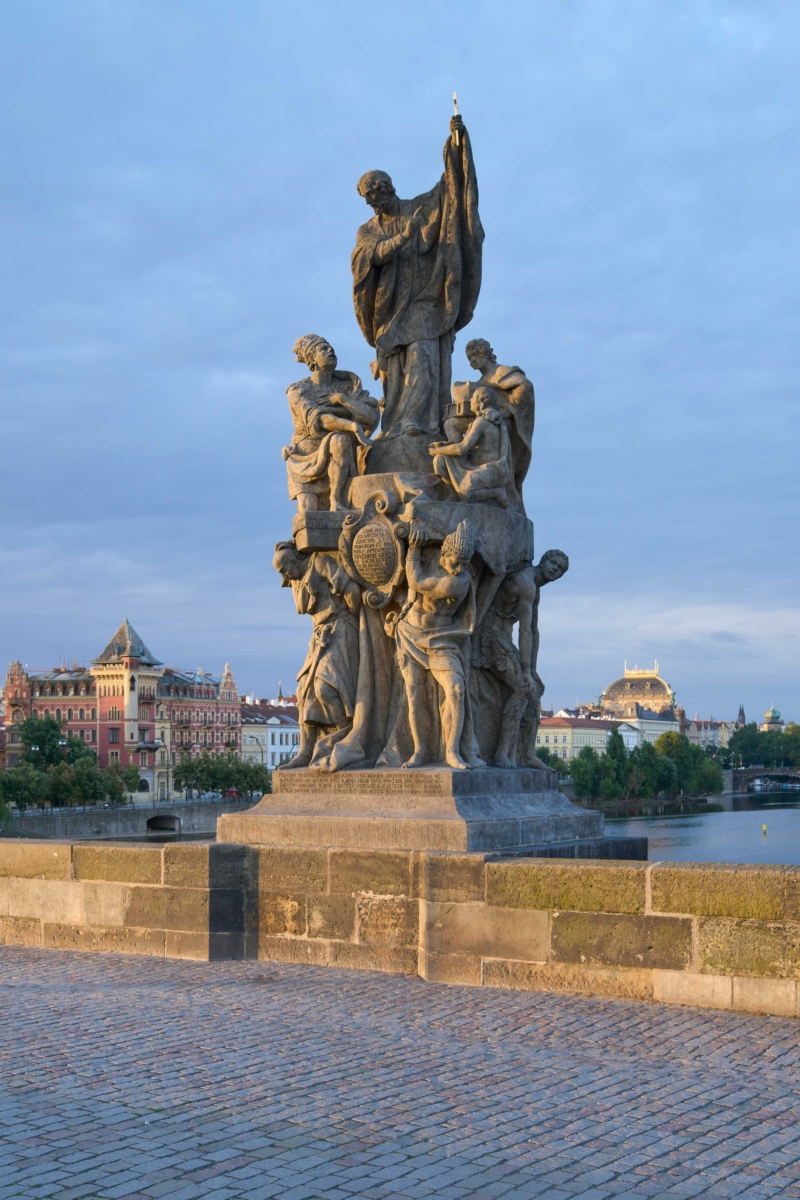
Sculpture of St. Francis Xavier
The monumental sculpture of St. Francis Xavier was completed in 1711 in the workshop of Johann Brokoff, under the supervision of Ferdinand Maximilian Brokoff. The work was commissioned by the Jesuit Order, namely the Faculty of Theology and Philosophy at Charles-Ferdinand University. The sculpture is signed with the Latin inscription: “OPUS IOANNIS BROKOFF” and dated with an inscription in a cartouche. During the 1848 fights, the sculpture was severely damaged, and during the flood of 1890 it collapsed into the river. Today, the original sculpture is stored in the Lapidarium of the National Museum, assembled from the salvaged fragments and further reconstructed by sculptor Čeněk Vosmík between 1898 and 1905. Vosmík is also the creator of the current copy, likely made of Doubrava sandstone, which was installed in place of the collapsed sculpture at the end of 1912.
Before commissioning the sculpture group to Brokoff’s workshop, the Jesuits also commissioned a design for the sculpture from the prominent painter Petr Brandl, who probably cooperated with the workshop of competing sculptor, Matthias Bernard Braun. Brokoff’s initial design from 1709 was criticized primarily for its excessive dimensions. Another sketch has also survived, made by Jan Jiří Heintsch, who had previously collaborated with the Brokoff workshop on a design for a statue of St. Francis Borgia.
The sculpture with a naturalist composition depicts the prominent Jesuit missionary on a stone slab, carried by four allegorical figures representing the “subdued” pagan nations, among whom Francis Xavier performed his missionary activities and thereby contributed to their Christianization. In the front, there’s a Tatar figure with two swords on the left, and a Moor on the right; in the back, there’s a Chinese man on the left, and an Indian on the right. In the upper part of the sculpture, a pagan king kneels before the standing figure of St. Francis Xavier and asks for baptism; the younger of the two youths kneeling on the right side of the sculpture brings a baptismal shell. The sculptor’s self-portrait is recognized in the face of the young man in the background, holding a book with a biretta.